

Many owners of century-old homes in Heritage Hill, East Hills, Midtown, and other similar Grand Rapids neighborhoods assume that insulating means tearing into their home’s original plaster walls, so they never upgrade at all. Yet with heating and cooling accounting for close to half a home’s yearly energy costs, that assumption costs them real money every Michigan winter.
According to data gathered by the U.S. Energy Information Administration, homes built before 1950 are roughly 30 to 40% less energy efficient than homes built after 2000. These homes were often built with empty wall cavities and little to no attic insulation, leaving many homeowners paying outrageous energy bills for uncomfortable homes.
The good news is a century-old Grand Rapids home can be insulated without removing valuable plaster. Follow a preservation-first sequence to help ensure the original plaster, trim, and siding stay right where they belong while improving the home’s energy efficiency.
Start with air sealing and attic insulation for the least invasive project with the biggest return and end with dense-pack cellulose insulation blown into your walls through small, patchable access points. Exterior work in a historic district needs city sign-off first, but that review protects the neighborhood rather than slowing a good project down.
Curious what your walls and attic currently hold? A free in-home insulation evaluation is a way to find out.
Why Heritage Hill Homes Lose So Much Heat — and Why That’s Fixable
Most pre-1930 Grand Rapids homes were built with empty stud cavities, since insulation was not yet standard practice. Many are balloon-framed with wall cavities that run continuously from the foundation to the attic, creating open spaces for air movement between floors. The stack effect pulls the home’s cold basement air up through those cavities and out the attic. Up to a third of a home’s heat escapes through an uninsulated or under-insulated attic in winter.
Grand Rapids and Kent County sit in Michigan Climate Zone 5A insulation territory, where state code sets energy targets of R-38 for ceilings with attic space, R-20 (or R-13+5) for wood-frame walls, and R-10/13 for basement walls. These numbers were written for new construction; for retrofit, they work best as a target to grow into. A 30-40% efficiency improvement is seen as realistic for a home that has had minimal upgrades since construction. With insulation upgrades, it’s been shown that homeowners can save about 15% on energy bills.
The Preservation-First Order of Operations
 The National Park Service recommends starting with whatever upgrade needs the least alteration.
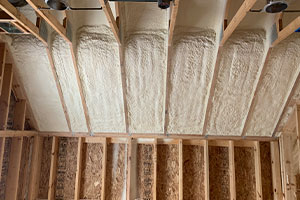
Step 1: Air sealing an old house comes first. Seal the top and bottom of exterior walls, gaps between floors, and open chases so conditioned air stays put. Install spray foam insulation to rim joist and basement cracks. This is the one appropriate use of foam in a plaster-safe retrofit.
Step 2: Attic insulation for a historic home in Michigan comes next. Adding blown-in insulation, such as fiberglass insulation, between the floor joists is simple and effective and causes almost no disruption to the house.
Step 3: Storm windows for a historic home matter too. A quality storm window paired with the original window can approach the thermal performance of a double-glazed replacement, addressing about 10% of total air loss.
Historic District Approval
Heritage Hill is a locally designated historic district. Any exterior changes, improvements or repairs in a historic district requires a Certificate of Appropriateness from Grand Rapids. Interior, attic, and basement work generally fall outside that review, but call the GR Planning Department to double check before starting on any work that might touch siding or the visible exterior.
The Plaster-Safe Wall Method: Dense-Pack Cellulose
Once air sealing, the attic, and the basement are handled, walls are last. The National Park Service identifies blown-in, dense-pack insulation as the method that causes the least damage to historic materials and finishes when insulating wood-frame walls. When packed correctly, dense-pack cellulose insulation or fiberglass insulation completely fills a cavity, resists settling, and slows airflow through the wall. Blown-in cellulose insulation conforms to oddly shaped spaces without disturbing plaster, delivering an R-value of roughly R-3.1 to R-3.8 per inch when professionally installed at the right density.
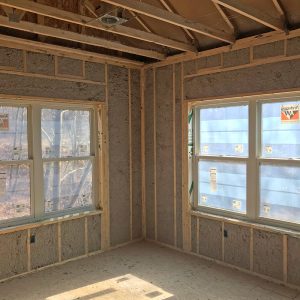 Curious how cellulose holds up once winter sets in? Here’s how cellulose performs in Michigan’s Climate Zone 5A.
When historic interior plaster is intact, installers reach the wall from outside. A few siding boards temporarily come off at the top of each cavity, the insulation goes in, and the boards go back on with no visible drill holes left. Interior drill-and-fill is reserved for walls already due for repair.
It’s important to use borate cellulose insulation for your home rather than sulfate-treated cellulose, since sulfate can react with moisture to form an acid that corrodes metal inside the wall. Spray foam is useful at rim joists and basements but should stay out of enclosed plaster walls. It bonds permanently to historic materials, and its expansion pressure can crack plaster finishes or break plaster keys.
Frequently Asked Questions
Can you insulate an old house without removing the plaster?
Yes. Dense-pack insulation goes in through the exterior siding, while attic and basement work never touch plaster.
Do I need approval to insulate a home in Heritage Hill?
You shouldn’t. Homeowners are required to obtain a Certificate of Appropriateness (COA) from Grand Rapids for exterior changes in a historic district. Interior and attic work are usually outside that scope. Verify with the Grand Rapids Planning Department before starting any exterior access work.
Is spray foam safe for old plaster walls?
Not inside enclosed plaster cavities, since expansion pressure can crack the plaster. It works well at rim joists, basements, and other exposed framing.
What insulation levels should a Michigan Zone 5A home target?
The minimum, prescriptive path calls for R-38 for ceilings, R-20 for walls, and R-10/13 for basement walls. These should be treated as retrofit goals rather than strict requirements.
What about knob and tube wiring?
Have an electrician deactivate or replace active knob and tube wiring in the walls before dense packing insulation, since live wiring blocks proper coverage.
Ensure Your Century-Old Home Is Ready for the Next 100 Years
A century-old home isn’t an obstacle to efficiency. It’s a candidate for a 30 to 40% improvement. When completed in the right order — seal, attic, basement, storm windows, plaster-safe dense-pack walls —your Heritage Hill home’s original plaster, trim, and siding can be preserved.
Whitson Insulation Company has served Grand Rapids and western Michigan since 1978, with decades of experience working with Heritage Hill historic district insulation. We’re committed to taking care of your home as if it were our own. Contact us today at 616.698.0490 or visit us online to request a free in-home evaluation to find out what your walls and attic hold.
References
Arizona State University Energy Efficiency Center. “Energy Savings by Insulation.” ASU Energy Efficiency Center, 11 July 2023, https://eec.asu.edu/2023/07/11/energy-savings-by-insulation/.
City of Grand Rapids. “Apply for a Certificate of Appropriateness for an Existing Structure.” City of Grand Rapids, Michigan, www.grandrapidsmi.gov/government/boards-commissions/historic-preservation-commission/apply-for-a-certificate-of-appropriateness-for-an-existing-structure/.
Hensley, Jo Ellen, and Antonio Aguilar. “Preservation Brief 3: Improving Energy Efficiency in Historic Buildings.” Technical Preservation Services, National Park Service, U.S. Department of the Interior, 2011, www.nps.gov/orgs/1739/upload/preservation-brief-03-energy-efficiency.pdf.
Michigan Department of Environment, Great Lakes, and Energy. “Residential Energy Code — Michigan Climate Zone 5a Checklist.” State of Michigan, www.michigan.gov/-/media/Project/Websites/egle/Documents/Programs/MMD/Energy/resources/residential-chklst-z5.pdf.
Michigan State University Extension. “Improving Home Insulation for Savings and Comfort: Part 2 — Types of Insulation.” MSU College of Agriculture and Natural Resources, 23 Oct. 2014,www.canr.msu.edu/news/improving_home_insulation_for_savings_and_comfort_part_2_types_of_insulatio.
Michigan State University Extension. “Improving Home Insulation for Savings and Comfort: Part 4 — Where to Install Insulation.” MSU College of Agriculture and Natural Resources, 10 Nov. 2014, www.canr.msu.edu/news/improving_home_insulation_for_savings_and_comfort_part_4.
Pacific Northwest National Laboratory. “Blown Insulation for Cavities of Existing Exterior Walls.” Building America Solution Center, U.S. Department of Energy, https://basc.pnnl.gov/resource-guides/blown-insulation-cavities-existing-exterior-walls.