
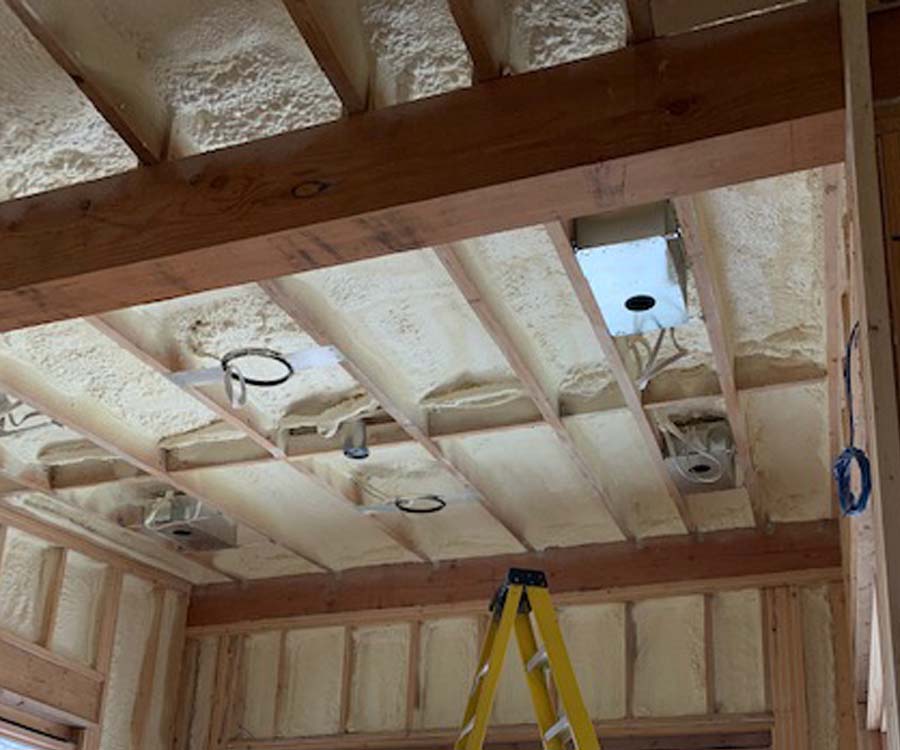
The right spray foam thickness for a Michigan home isn’t a single number. It depends on whether the foam is open-cell or closed-cell, which part of the home is being insulated, and which Michigan climate zone the home sits in. For example, Grand Rapids and the lower peninsula are mostly Zone 5A; much of northern Michigan is Zone 6A or 7.
Michigan’s current residential energy code — the 2015 Michigan Energy Code, still in effect statewide — sets minimum R-values of R-49 for ceilings and R-20 (or R-13+5) for wood-frame walls in Zone 5A, with even higher ceiling R-values required further north; when spray foam is installed too thin to hit those R-values, homes fail inspection, waste heating energy, and stay uncomfortable through long Michigan winters.
Michigan homeowners invest in spray foam to handle long winters and humid summers, but many don’t know the proper spray foam thickness Michigan homes actually require. Too little foam underperforms and wastes energy. Too much foam wastes money without adding real efficiency. Worse, incorrect thicknesses in basements, crawl spaces, and rim joists can trap moisture and cause long-term damage.
This guide pairs code-required R-values for each Michigan climate zone with the DOE-published R-value per inch for both open-cell and closed-cell spray foam, so readers can see exactly how many inches of foam they need in their attic, walls, rim joists, and crawl space.
For a typical Grand Rapids-area home in Climate Zone 5A:
- Ceiling spray foam should be roughly 8 inches of closed-cell foam.
- Wall cavities need about 2–3 inches of closed-cell insulation, or the full 3.5 to 5.5 inch stud-bay depth of open-cell insulation, to reach R-20
- Rim joists and crawl space walls are typically specified at 2–3 inches of closed-cell insulation to act as both insulation and a vapor retarder in Michigan’s wet, freeze-thaw conditions.
Open-cell foam delivers roughly R-3.5 per inch while closed-cell foam delivers roughly R-6 per inch, so thickness requirements always come back to foam type.
Not sure whether your attic or basement has enough foam to hit Michigan code, or whether open-cell or closed-cell is right for the job? An insulation evaluation can determine what you have and what you need.
How Spray Foam R-Value Works in Michigan
Open-Cell vs. Closed-Cell: The R-Value Difference
The U.S. Department of Energy classifies spray polyurethane foam into two types: low-density open-cell foam, which uses air as the blowing agent and has a softer, more vapor-permeable structure; and high-density closed-cell foam, which uses a gas blowing agent trapped inside sealed cells, giving it a much higher R-value per inch and natural moisture resistance.
According to DOE guidance, closed-cell polyurethane foam is among the most efficient insulating materials commercially available, with R-values of R-6 to R-7 per inch; open-cell polyurethane foam typically delivers around R-3.5 per inch.
What this means in plain terms: 1 inch of closed-cell foam insulates roughly as well as 2 inches of open-cell foam, so the required thickness to hit any target R-value depends entirely on which product is being installed.
This is why asking “how thick should spray foam be” without specifying the type leads to conflicting answers.
Why R-Value Alone Doesn’t Tell the Whole Story
Spray foam doesn’t just insulate. It also air seals. The DOE notes that spray foam insulation fills even the smallest cavities and creates an effective air barrier, which is critical in Michigan because heating and cooling account for a large share of annual home energy use, and uncontrolled air leakage multiplies those costs during long heating seasons.
In Michigan’s freeze-thaw climate, the air-sealing function of spray foam is as important as the stated R-value — a wall with R-20 of fiberglass full of air leaks will underperform a wall with R-20 of spray foam that has no leaks at all.
Air leakage can account for a major portion of energy loss. Spray foam fills gaps that traditional insulation misses, which makes it especially effective in areas like the rim joist spray foam application zone, also known as the basement box sill.
Even if two materials have the same R-value, the one that air seals better will perform better in real-world conditions.
Michigan Code R-Value Targets by Climate Zone
Michigan Climate Zones
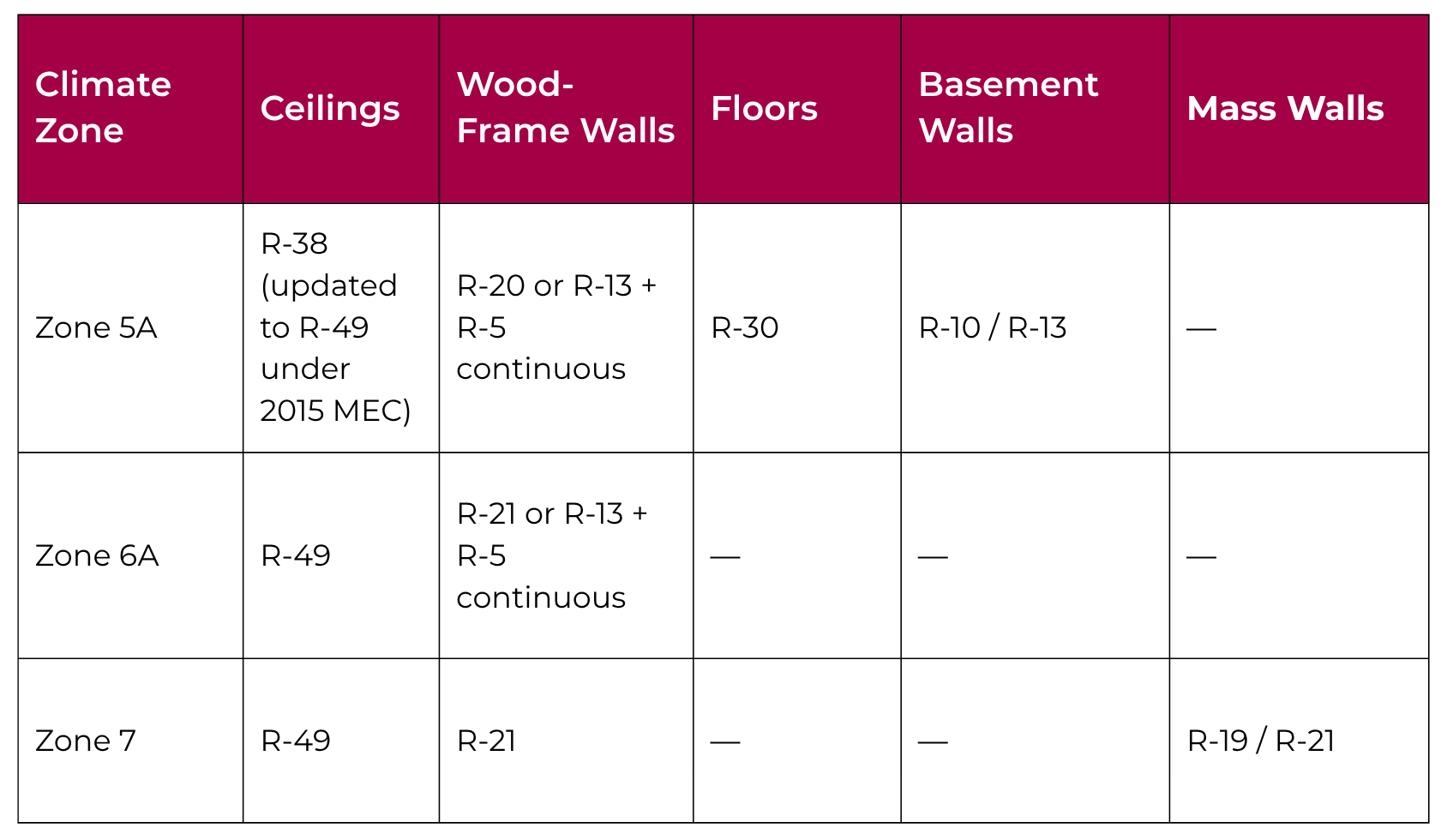 Michigan spans three zones:
- Zone 5A: Most of the lower peninsula (including Grand Rapids, Kalamazoo, Lansing, and Detroit)
- Zone 6A: The northern lower peninsula and eastern upper peninsula
- Zone 7: The far western upper peninsula
Most homeowners fall under Michigan climate zone 5A insulation requirements, with stricter standards in Michigan climate zone 6A insulation areas.
The Michigan residential energy code compliance checklist for Zone 5A, published by the Michigan Department of Environment, Great Lakes, and Energy (EGLE), outlines these minimums along with required air sealing, duct sealing, and energy certificate provisions.
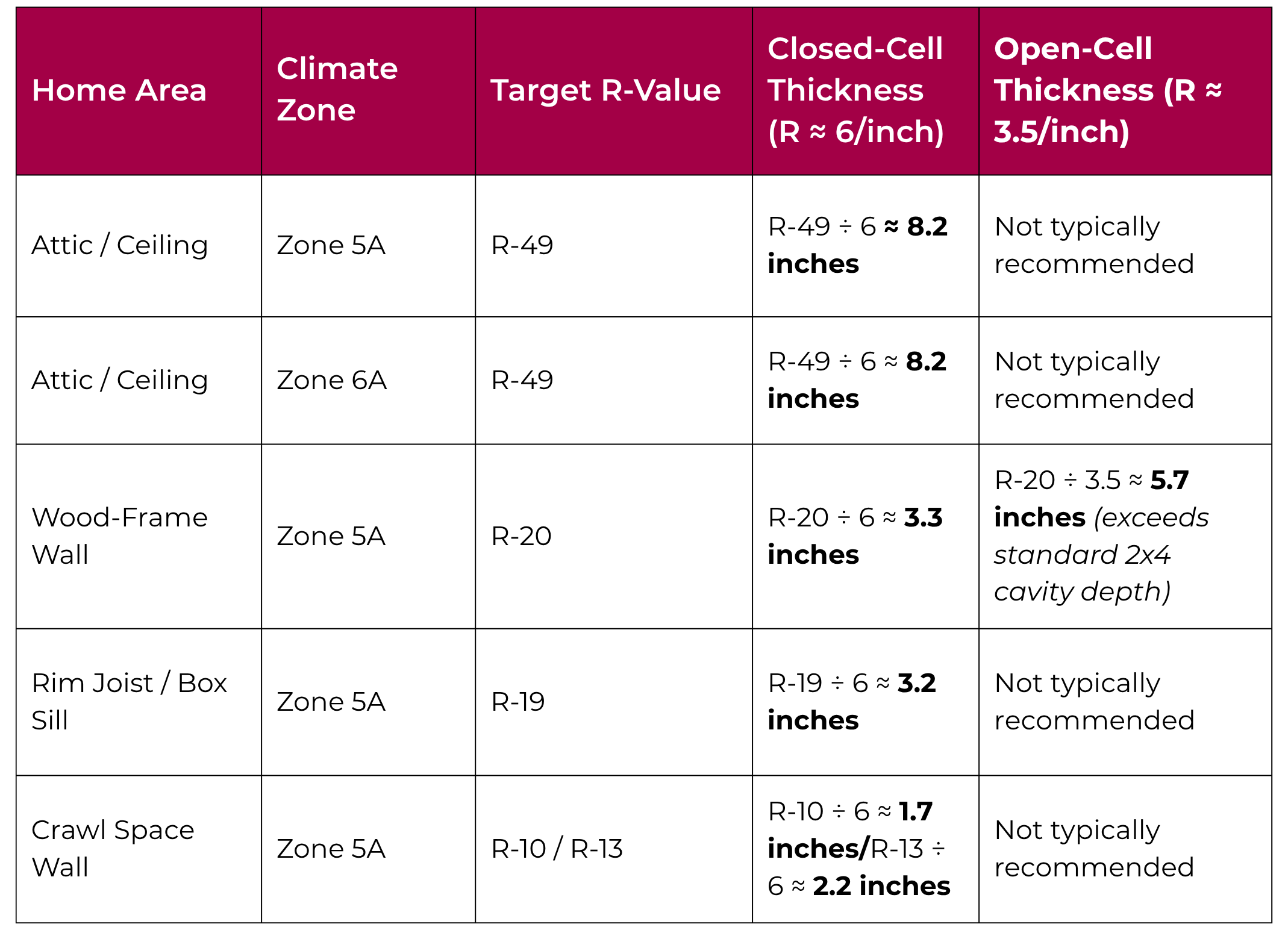
Converting Code R-Values to Spray Foam Thickness
Here’s exactly how Michigan code R-values translate into spray foam thickness:
Proper Spray Foam Thickness by Home Area
Attics and Roof Decks
When it comes to attic spray foam thickness, there are two common scenarios:
- Attic floors (vented attic): Reaching Michigan’s R-49 ceiling target requires roughly 8 inches of closed-cell foam.
- Unvented attic / sealed roof deck: Closed-cell foam at 4–5 inches thick against the underside of the roof sheathing creates a conditioned attic with an air seal that moves the dew point outside the sheathing, helping protect against ice damming on Michigan winter roofs.
Walls
For wall spray foam thickness:
- 2×4 walls:
- 2–3 inches of closed-cell foam delivers ≈ R-12–R-18 and provides a vapor retarder. Consider pairing it with continuous exterior insulation (R-5 sheathing) to meet the Zone 5A R-20 wall target
- 2×6 walls:
- 3 inches of open-cell (≈ R-10) is commonly used for budget interior wall installs
- For exterior walls a flash-and-batt design (1–2 inches closed-cell flash coat plus cellulose or fiberglass fill) is a frequent Michigan approach
This is where hybrid insulation systems can be a cost-effective solution.
Rim Joists / Box Sills
The rim joist at the top of a Michigan basement is one of the leakiest areas of a typical home. Uninsulated basements alone account for 10–30% of total heat loss in many Michigan homes. It is recommended to use 2 to 3 inches of closed-cell foam at the rim joist, as this thickness creates a vapor retarder, air seal, and thermal break in a single application and is the single highest-return spray foam upgrade for most Grand Rapids-area homes.
Crawl Spaces
For crawl space spray foam Michigan applications in an encapsulated crawl space, use 2 to 3 inches of closed-cell foam on the interior of the crawl space walls from the top of the foundation down to the slab, with a continuous vapor barrier on the floor.
Open-cell foam is generally not recommended below grade in Michigan’s humid, damp crawl spaces because its open-cell structure can absorb moisture.
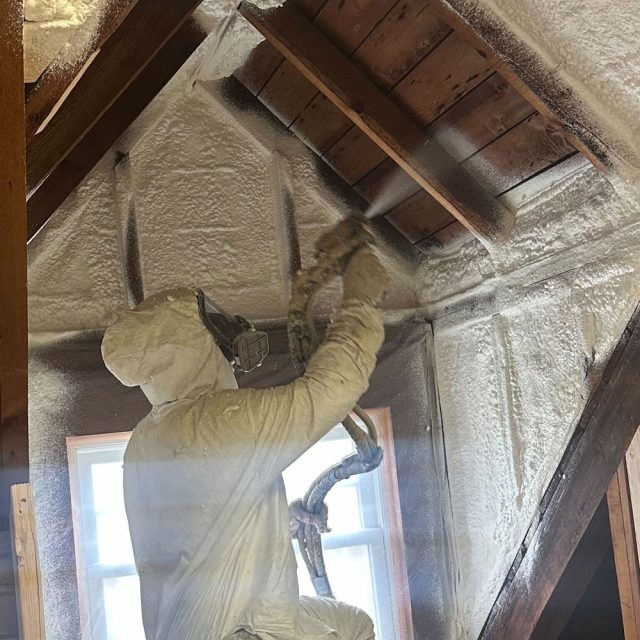 What Happens If Spray Foam Thickness Is Wrong?
Too Thin
- Misses the target R-value
- Fails to fully air seal
- Leads to heat loss and higher energy bills
- Increases condensation risk
Too Thick
- Wastes material and money
- Diminishing returns on added R-value
- In confined cavities can over-expand and stress framing
Spray Foam Thickness Is an Equation
The correct spray foam insulation thickness Michigan homes need comes down to this: the code-required R-value ÷ foam R-value per inch.
For most Zone 5A homes, including Grand Rapids-area homes:
- Attics/roof decks: ~8 closed-cell
- Walls: 2–3 inches closed-cell in a 2×4 cavity
- Rim joists: ~2–3 inches closed-cell
- Crawl spaces: ~2–3 inches closed-cell
Anything less underperforms, while anything more wastes money. The right installer specs the exact thickness for each area rather than applying a single blanket number across the whole home.
Ready to get the thickness right the first time? Whitson Insulation has been installing spray foam, fiberglass, and cellulose in West Michigan since 1978, and our team sizes every job to Michigan Energy Code — not a one-size-fits-all number. Call (616) 698-0490 or contact us for a free in-home evaluation.
References:
Michigan Department of Environment, Great Lakes, and Energy. “Energy Efficiency in Michigan Homes — Residential Energy Code Climate Zone 5A Checklist.” State of Michigan, www.michigan.gov/-/media/Project/Websites/egle/Documents/Programs/MMD/Energy/resources/residential-chklst-z5.pdf.
Michigan Department of Environment, Great Lakes, and Energy. “Michigan Energy Codes Compliance Collaborative.” State of Michigan, www.michigan.gov/egle/about/organization/materials-management/energy/codes.
Michigan Department of Environment, Great Lakes, and Energy. “Home Energy Rebates (MiHER).” State of Michigan, www.michigan.gov/egle/about/organization/materials-management/energy/rfps-loans/home-energy-rebate-programs.
Michigan State University Extension. “Reference Guide: Michigan Uniform Energy Code.” Michigan State University, www.canr.msu.edu/spdc/uploads/files/energycodes/MSHDA%20Reference%20Guide.pdf.
Michigan State University Extension. “Improving Home Insulation for Savings and Comfort: Part 3.” Michigan State University, www.canr.msu.edu/news/improving_home_insulation_for_savings_and_comfort_part_3_determining_insula.
U.S. Department of Energy. “Insulation Materials.” Energy Saver, www.energy.gov/energysaver/insulation-materials.
U.S. Department of Energy. “Types of Insulation.” Energy Saver, www.energy.gov/energysaver/types-insulation.
U.S. Department of Energy. “Insulation.” Energy Saver, www.energy.gov/energysaver/insulation.