
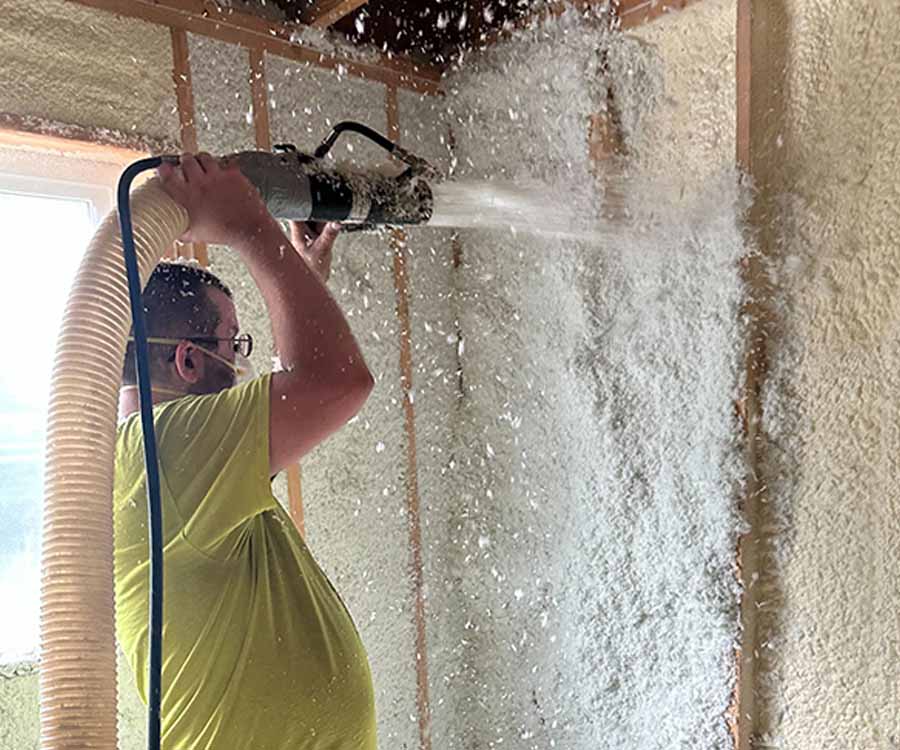
Many West Michigan builders want the tight seal of spray foam on new construction walls. Yet a full cavity of foam doesn’t fit every project. Hybrid walls offer a practical middle path.
In a climate zone 5A winter, a wall filled only with air-permeable insulation can fail the blower-door test at final inspection. Fiberglass, cellulose, or blown insulation products let air move through them and do not stop air leakage on their own. Michigan’s residential energy code also requires a continuous air barrier and a verified air leakage test. Air-permeable insulation cannot be used as a sealing material.
Hybrid wall insulation solves this problem. A hybrid wall uses closed-cell spray foam to air-seal the sheathing, while fibrous insulation fills the remaining cavity depth. In cold climates, the foam layer must be thick enough compared to the total wall R-value to keep the condensing surface warm.
The Arizona State University (ASU) Energy Efficiency Center, citing the Department of Energy (DOE), reports that adding appropriate insulation can save homeowners an average of 15% on their electricity bills.
What a Hybrid Wall Actually Is
The two layers, in order
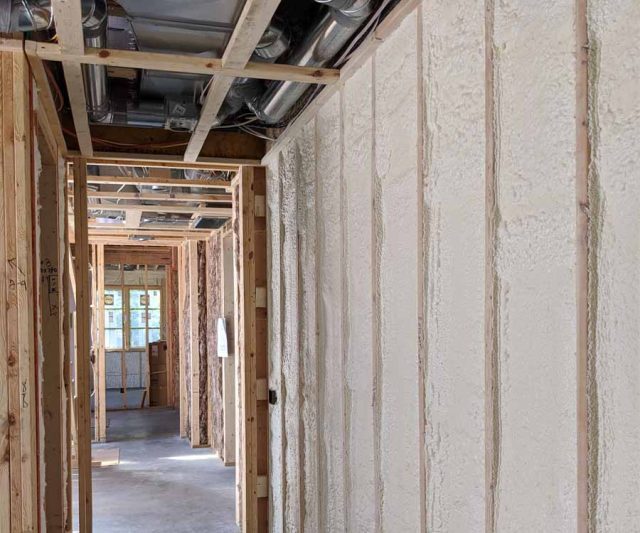 This hybrid insulation system, or spray foam and fiberglass combination, goes in one layer at a time. First, the installer sprays closed-cell spray foam insulation onto the inside face of the wall sheathing. Next, a fiberglass insulation batt or mineral wool fills the cavity to the stud face. Blown fiber works too. The foam handles air control, and the fiber layer adds R-value more economically.
Why the foam carries the air-control job
Fibrous insulation allows air paths, so it cannot control air leakage alone. A full-depth foam cavity seals and insulates with foam alone. A full-depth fiber cavity adds R-value but leaves air control to other layers. A hybrid cavity lets the foam seal the wall while the fiber fills the depth.
Where hybrid stops
The foam sits inside the cavity, so exterior continuous insulation outside the sheathing is a separate assembly. The wall still needs a detailed water control layer and proper flashing at openings.
Getting the Foam Ratio Right in Climate Zone 5A
Why Kent County’s zone drives the whole decision
DOE Building America and the 2021 International Energy Conservation Code (IECC) place Kent County in climate zone 5A. Zone 5A is classified as a cold and humid climate. Be sure to check your zone by county rather than by city, since some neighboring West Michigan counties fall outside zone 5. Michigan climate zone 5A walls may need a different plan than walls farther north.
The condensation rule in one sentence
The foam share of total R-value has to rise as the climate gets colder.

Closed-cell foam controls condensation from indoor moisture by warming the surface where it could form. As outdoor temperatures drop, the wall needs more insulation to keep the sheathing warm. In new construction, the foam serves as the vapor control layer, and the amount needed depends on the climate zone. That ratio is the heart of any condensation control wall assembly.
Where the numbers come from
Ratio guidance traces back to the Class III vapor retarder tables in the 2009 and 2012 International Residential Codes (IRC). Their minimum values for insulating sheathing also apply to closed-cell foam on the inside of the sheathing.
Check the DOE’s Building America Solution Center (BASC) Table 1 and Michigan’s most current adopted residential code for your exact foam share of total R-value. Then confirm it with your local code official. Learn more in our guide on proper spray foam thickness for Michigan homes.
Interior finish side
Hybrid walls with sufficient vapor control need only latex paint, a Class III vapor retarder, on the interior. Remember to avoid adding an interior polyethylene sheet by default and check the adopted code first.
Which West Michigan Projects Hybrid Fits
Good-fit projects
Hybrid walls suit:
- New construction 2×6 walls where full-depth foam is not in scope, but the home must still pass its air leakage test. They give closed-cell spray foam new construction projects an air seal without a full foam cavity. For builders comparing 2×6 wall insulation cold climate options, that balance is hard to beat.
- Projects using the prescriptive path, where Michigan wood frame walls need R-20 cavity insulation or R-13 cavity plus R-5 continuous insulation.
- Projects where builders want a single trade handling both layers before drywall.
- Multifamily and commercial insulation projects.
For more on local conditions, see our Grand Rapids climate zone 5A insulation guide.
Why winter is when the difference shows
Michigan’s amended 2015 IECC requires the home to test at 4 ACH50 or less. ACH50 means air changes per hour at 50 pascals of pressure. A 2021 code update is pending, but a July 2025 court order paused it, so the 2015 provisions remain in effect until further notice. On every air barrier new construction Michigan job, a continuous air barrier is mandatory.
In winter, warm air escapes near the top of the house and pulls cold air in down low. This “stack effect” makes leaks easier to feel and easier to spot during a blower door test Michigan inspectors review.
Execution details that decide the result
Foam-insulated walls can still leak where wood meets wood. Doubled studs and framed corners are common trouble spots. So are headers and sill plates. The fix is to seal all wood-to-wood joints from the interior.
 Spray foam is essentially made on site, so quality control matters. Installers check surface moisture and temperature. They also watch lift thickness and the mix ratio of the two foam components. Cold weather affects each of these, so winter jobs need careful scheduling.
A tighter home also makes combustion safety and mechanical ventilation part of the plan. Avoid running plumbing in exterior walls in cold climates. If you must, add insulation on the outside of the pipe.
Frequently Asked Questions
What is hybrid insulation?
Hybrid insulation, also called the hybrid approach, is when a wall cavity has closed-cell spray foam sprayed against the sheathing and fibrous insulation filling the rest.
How thick does the foam layer need to be?
It depends. The foam must keep the condensing surface above the dew point, the temperature at which moisture turns to liquid. Colder climates require a higher ratio of vapor-impermeable foam to total insulation. Check the adopted code and your local code official for the governing value.
Does hybrid insulation need a poly vapor barrier?
Hybrid walls with sufficient vapor control only need latex paint, a Class III vapor retarder, inside. Confirm this against Michigan’s current residential code before finalizing interior details.
Will a hybrid wall pass a Michigan blower-door test?
Michigan’s current amended 2015 IECC requires 4 ACH50 or less. A 2021 update is pending but paused by court order, so confirm the number at permit time. Passing depends as much on the foam and on sealing wood-to-wood joints and penetrations.
Build Warmer, Tighter Walls from the Start
The foam layer is an air and condensation control decision. Kent County sits in climate zone 5A, and the foam share of total R-value must rise with colder design conditions. Specify the wall assembly before framing is closed in, because the blower-door test only confirms what was built.
For insulation expertise you can count on, turn to Whitson Insulation. Our team has served West Michigan since 1978, and we know how local winters test every wall. Let us review the wall assemblies for your next build. Start by exploring our spray foam insulation services.
References
Antonopoulos, Chrissi, et al. Guide to Determining Climate Zones by County: Building America and IECC 2021 Updates. PNNL-33270, Pacific Northwest National Laboratory, Sept. 2022, https://www.pnnl.gov/main/publications/external/technical_reports/PNNL-33270.pdf.
“Currently Open Rules.” Michigan Department of Licensing and Regulatory Affairs, Bureau of Construction Codes, www.michigan.gov/lara/bureau-list/bcc/rules-acts/rules/currently-open.
“Double Walls for More Insulation.” Building America Solution Center, Pacific Northwest National Laboratory for the U.S. Department of Energy, https://basc.pnnl.gov/resource-guides/double-walls-more-insulation.
“Mich. Admin. Code R. 408.30547d – [Effective until 8/29/2025] Building Thermal Envelope.” Legal Information Institute. Cornell Law School, https://www.law.cornell.edu/regulations/michigan/Mich-Admin-Code-R-408-30547d#:~:text=Air%2Dpermeable%20insulation%20shall%20not%20be%20used%20as%20a%20sealing%20material.
“Residential Energy Code: Michigan Climate Zone 5a.” Michigan Department of Environment, Great Lakes, and Energy, www.michigan.gov/-/media/Project/Websites/egle/Documents/Programs/MMD/Energy/resources/residential-chklst-z5.pdf.
“Spray Foam Insulation for Cavities of Existing Exterior Walls.” Building America Solution Center, Pacific Northwest National Laboratory for the U.S. Department of Energy, https://basc.pnnl.gov/resource-guides/spray-foam-insulation-cavities-existing-exterior-walls.
Vermeer, Trenton. “Energy Savings by Insulation.” ASU Energy Efficiency Center, Arizona State University, 11 July 2023, https://eec.asu.edu/2023/07/11/energy-savings-by-insulation/.