
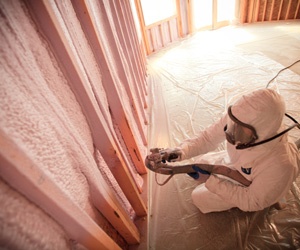
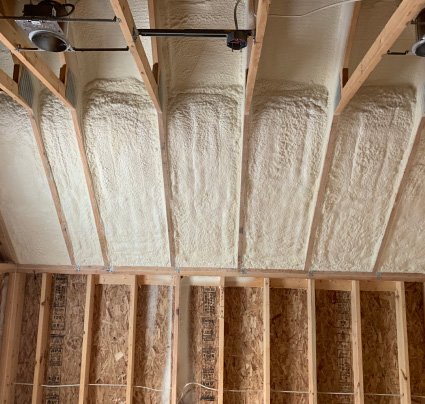
Spray foam insulation is becoming a go-to solution for homeowners and builders across Grand Rapids and Western Michigan. This type of insulation is a polyurethane foam made of two components that are sprayed onto surfaces like walls, ceilings, and floors. The foam expands, hardens, and forms a strong seal that provides both insulation and air sealing in one application.
That’s especially important here in Michigan, where heating and cooling make up around 43% of your total home energy use. In this post, we’ll explore the pros and cons of spray foam insulation, with tips specific to Michigan’s climate and homes.
The Advantages of Spray Foam Insulation
Superior Energy Efficiency and Air Sealing
Spray foam forms an airtight seal, filling every crack, gap, and hidden leak in your home’s envelope. Michigan’s building code requires that every new home’s thermal envelope should be constructed to limit air leakage. Done right, this can help reduce your heating and cooling needs by up to 30%.
Our state falls into climate zones 5 and 6, which means attics should have insulation rated at a minimum of R-38 for zone 5 and R-49 for zone 6. Spray foam helps lock in conditioned air, reduce energy bills, and keep temperatures steady all year.
Long-Term Durability
Once it hardens, spray foam stays in place for decades. It doesn’t sag or settle over time like loose-fill or batt insulation can. Closed-cell spray foam insulation is resistant to moisture and forms a vapor barrier, reducing the risk of mold and mildew. It’s a long-lasting, low-maintenance choice for homeowners who want to “set it and forget it.”
Remarkable Versatility
Spray foam adapts to hard-to-reach areas and irregularly shaped spaces. This is ideal for older homes where traditional insulation materials may fall short. There are two main kinds of spray foam to best meet your insulating needs:
Open-cell spray foam
It has an approximate R-value of R-3.7 per inch. It’s lightweight and excellent for soundproofing and air sealing.
Closed-cell spray foam
It has an approximate R-value of R-7 per inch. It’s denser than open-cell foam, adds structural strength and provides a vapor barrier.
Sound Dampening Qualities
By sealing cracks where noise infiltrates and absorbing sound vibrations, spray foam also reduces noise. This creates a quieter indoor environment that is especially noticeable in multi-story homes. Open-cell spray foam is highly effective at dampening sound between rooms.
Improved Indoor Air Quality
Spray foam reduces air leaks that let in pollen, dust, exhaust fumes, and humidity. It gives you better control over your indoor air and tightens your building envelope to keep pollutants out. Closed-cell spray foam especially helps maintain ideal humidity levels (between 30–50%). The result is cleaner, healthier air inside your home, especially when paired with a proper ventilation system.
When Spray Foam May NOT Be the Right Choice
Higher Initial Cost
 Spray foam costs more upfront per square foot than other materials like fiberglass or cellulose. But over time, it can pay for itself in energy savings. The payoff depends on your local energy rates, how long you plan to stay in your home, and your current insulation levels.
If your budget is tight, you might consider using spray foam in key areas, like your attic or crawl space, while using other materials elsewhere.
Professional Installation Required
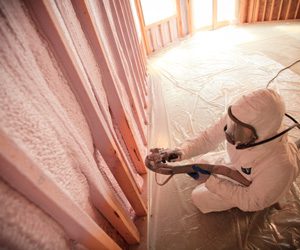
Spray foam installation is not a DIY job. Spray foam must be applied by trained professionals who use specific gear and equipment and follow specific safety precautions.
Always hire a licensed insulation contractor who knows Michigan’s building codes, such as Whitson Insulation Company. At the completion of each job, installers are required to provide certification that lists the R-value at the applied thickness.
“Over-Sealing” and Ventilation Concerns
If your home is too airtight it can trap indoor pollutants, like cooking fumes or off gassing from furniture, especially if there isn’t proper ventilation. Experts urge builders to follow the adage of “seal tight and ventilate right” to ensure a healthy home.
If you’re insulating your entire home with spray foam, be sure to include a ventilation plan, such as a heat recovery ventilator (HRV) or fresh air intake system.
Compatibility with Certain Materials & Structures
Spray foam isn’t always the right fit for every building. Michigan’s historic preservation standards prohibit foam in certain enclosed walls of historic structures. It also can’t be used around knob-and-tube wiring due to fire risk unless the wiring is upgraded. Spray foam may also conflict with certain roofing systems, window assemblies, and oil-based paints. In these cases, blown-in cellulose or fiberglass might be a better option.
It’s always best to consult with an insulation professional to make the most educated energy efficiency decisions for your home.
Limited Accessibility in Tight/Finished Spaces
Spray foam requires access for the installer to spray it. In fully finished areas, your walls will need to be opened up to install spray foam. Once applied, the foam is permanent and can make plumbing or wiring changes more difficult. Some homeowners and builders choose to use spray foam only in key areas and use removable insulation elsewhere.
Expert Installation for Your Michigan Home
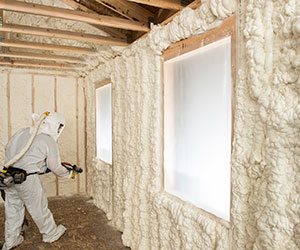 Spray foam insulation offers powerful benefits, especially in Michigan’s tough climate. It’s a type of insulation that not only seals and insulates in one step, but also provides long-term durability, noise reduction, and better indoor air quality.
However, it’s not a one-size-fits-all solution. Costs, ventilation needs, and home structure should all be considered. That’s why it’s important to work with a trusted professional.
At Whitson Insulation Company, we’ve been helping homeowners and builders across Grand Rapids and Western Michigan since 1978. Whether you’re insulating a new build or retrofitting an older home, we are here to help you make the most informed insulation choices for your home.
Contact us today for a free estimate and expert guidance on whether spray foam insulation is right for your project.
____________________________________________________________________________________
References
Big Rapids Township. (2011, April). MI uniform energy code. https://bigrapidstownshipmi.gov/wp-content/uploads/2022/01/MI-UNIFORM-ENERGY-CODE-Apr-2011-.pdf
Consortium for Advanced Residential Buildings. (April 2009.). Which spray foam is right for you? Energy.gov. https://www1.eere.energy.gov/buildings/publications/pdfs/building_america/spray_foam_guide.pdf
Environmental Protection Agency. (n.d.). Mold course chapter 2. Epa.gov. https://www.epa.gov/mold/mold-course-chapter-2#:~:text=%20Indoor%20relative%20humidity%20(RH)%20should%20be%20kept%20below%2060%20percent%20%2D%2D%20ideally%20between%2030%20percent%20and%2050%20percent%2C%20if%20possible.%20
Holladay, M. (n.d.). Spray-foam-insulated homes need ventilation. Green Building Advisor. https://www.greenbuildingadvisor.com/article/spray-foam-insulated-homes-need-ventilation
ICC Digital Codes. (n.d.) 2015 Michigan energy code- R402.4 air leakage. ICC Safe.org. https://codes.iccsafe.org/content/MIEC2015P1/chapter-1-re-energy-efficiency#MIEC2015P1_Pt02_Ch01_SecR402.4
ICC Digital Codes. (n.d.) 2015 Michigan energy code- R401.3 certificate. ICC Safe.org. https://codes.iccsafe.org/content/MIEC2015P1/chapter-1-re-energy-efficiency#MIEC2015P1_Pt02_Ch01_SecR401.3
Insulation Institute. (n.d.). 2015 Michigan residential energy code. North American Insulation Manufacturers Association. https://insulationinstitute.org/wp-content/uploads/2020/08/MI_Code-FINAL.pdf
Michigan Department of Environment, Great Lakes, and Energy. (n.d.). Michigan energy code compliance aid: whole house ventilation. Michigan.gov. https://codes.iccsafe.org/content/MIEC2015P1/chapter-1-re-energy-efficiency#MIEC2015P1_Pt02_Ch01_SecR401.3
Michigan Economic Development Corporation. (n.d.). Insulation for historic commercial resources. MiPlace Historic Preservation. https://www.miplace.org/historic-preservation/research-resources/publications/insulation-for-historic-commercial-resources/
Michigan Public Service Commission. (2024, July 16). Insulation EUL review. State of Michigan. https://www.michigan.gov/mpsc/-/media/Project/Websites/mpsc/workgroups/EWR_Collaborative/2024/Insulation-EUL-Review-2024-07-16.pdf
Michigan State University Extension. (n.d.). Improving home insulation for savings and comfort, part 2: Types of insulation. CANR News. https://www.canr.msu.edu/news/improving_home_insulation_for_savings_and_comfort_part_2_types_of_insulatio
Michigan’s Thumb. (n.d.). Spray foam’s versatility adds energy efficiency. https://www.michigansthumb.com/news/article/Spray-Foam-s-Versatility-Adds-Energy-Efficiency-9148666.php
U.S. Department of Energy. (n.d.). Home heating systems. Energy.gov. https://codes.iccsafe.org/content/MIEC2015P1/chapter-1-re-energy-efficiency#MIEC2015P1_Pt02_Ch01_SecR402.4
U.S. Department of Energy. (n.d.). Types of insulation. Energy.gov. https://www.energy.gov/energysaver/types-insulation#:~:text=Sprayed%2DFoam%20and%20Foamed%2DIn%2DPlace%20Insulation
U.S. Department of Energy. (n.d.) Why energy efficiency matters. Energy.gov. https://www.energy.gov/energysaver/types-insulation#:~:text=Sprayed%2DFoam%20and%20Foamed%2DIn%2DPlace%20Insulation